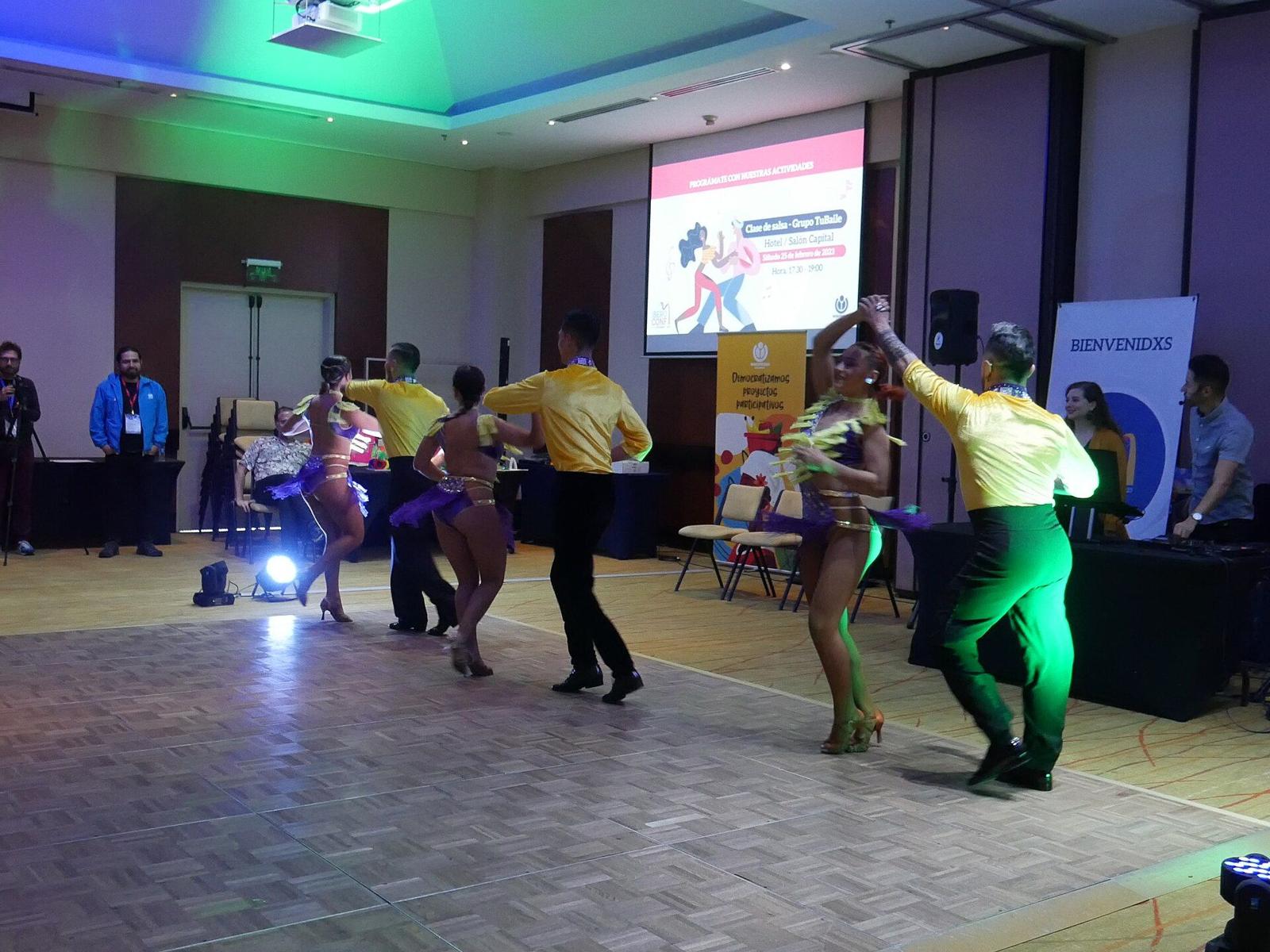
Brazilian Zouk is a partner dance from Brazil that grew out of lambada in the early 1990s. When the lambada craze faded, dancers kept its movements and began dancing them to slower Caribbean zouk records from the French Antilles. The dance changed, and it took the name of the music. Today it is known for its flowing body movement, head and torso work and close connection, and it is danced at festivals around the world.
Lambada first
Lambada was a Brazilian music and dance phenomenon of the 1980s, with roots in the north of the country. On the coast of Bahia, in Porto Seguro and nearby Arraial d'Ajuda, dancers developed it into a style with recognisable rules and competitions, borrowing from forró and other Brazilian dances.
In 1989, the French-Brazilian group Kaoma took the song "Lambada" around the world. For a short time, everybody wanted to learn the dance. Then the fashion passed, and new lambada music became harder to find.
A change of music
The Dance Current, a Canadian dance magazine, describes what came next. Dancers in Porto Seguro and São Paulo kept dancing lambada, but to the slower Caribbean music that was now on the dance floors: zouk, the music made famous by Kassav'. That is the origin of the style now called lambazouk, the closest to its lambada roots.
The music is the reason the name is confusing. Zouk is a French Caribbean genre and the word means "party" in Antillean Creole. The Brazilian dance borrowed it, and the community later settled on "Brazilian Zouk" to tell the dance apart from the music. For the music itself, read our story of Kassav' and zouk.
Rio de Janeiro
According to the Brazilian Zouk Dance Council, the transition in Rio de Janeiro was led by two teachers, Adílio Porto and Renata Peçanha. They are credited with creating what is now called traditional or Rio-style zouk.
Their background was different from the Porto Seguro dancers'. Both had trained in many dances, including ballroom, samba de gafieira, bolero, tango, ballet and jazz. The Dance Current reports that, without lambada music, Porto adapted a new basic step from samba that was easy to teach, and Peçanha added movements from other dance forms. Interviewed by Zoukology in 2015, she described developing basic figures such as the lateral and the bonus together with Adílio.
Styles
Brazilian Zouk now has several branches. The best known:
- Traditional or Rio-style zouk, built on named basic figures and a clear structure, which can be linear or circular.
- Lambazouk, from Porto Seguro, with constant movement and the closest link to lambada.
- Neo zouk and other contemporary approaches, which bring in movement from contemporary dance and play with R&B, pop and electronic music.
Some of these labels are claimed by particular teachers or schools, and dancers do not always agree where one style ends and another starts.
Why dancers love it
Zouk is famous for head movements and long, continuous waves through the body, and for a lead and follow that works through the whole torso, not only the hands. That is also why good teachers insist on technique: head movements done badly can hurt the neck.
Like kizomba, Brazilian Zouk lives at festivals and congresses. If you dance kizomba, you will find many of the same people, and some of the same love for connection, on the zouk floor.
FAQ
Is Brazilian Zouk the same as Caribbean zouk?
No. Zouk is a music from the French Caribbean, made famous by Kassav'. Brazilian Zouk is a partner dance from Brazil that was first danced to that music, then took its name.
Where does Brazilian Zouk come from?
From lambada. Dancers in Porto Seguro and in Rio de Janeiro kept dancing lambada movements to slower zouk records in the early 1990s, and the dance evolved from there.
Who created Rio-style zouk?
Adílio Porto and Renata Peçanha are credited with creating and systematising traditional, Rio-style Brazilian Zouk.
Sources
- Brazilian Zouk Dance Council, "History of Brazilian Zouk Dance"
- The Dance Current, "Zouk Alors! A look at the popular Brazilian social dance"
- Zoukology, Jessica Carro's interview with Renata Peçanha, Berg's Congress 2015