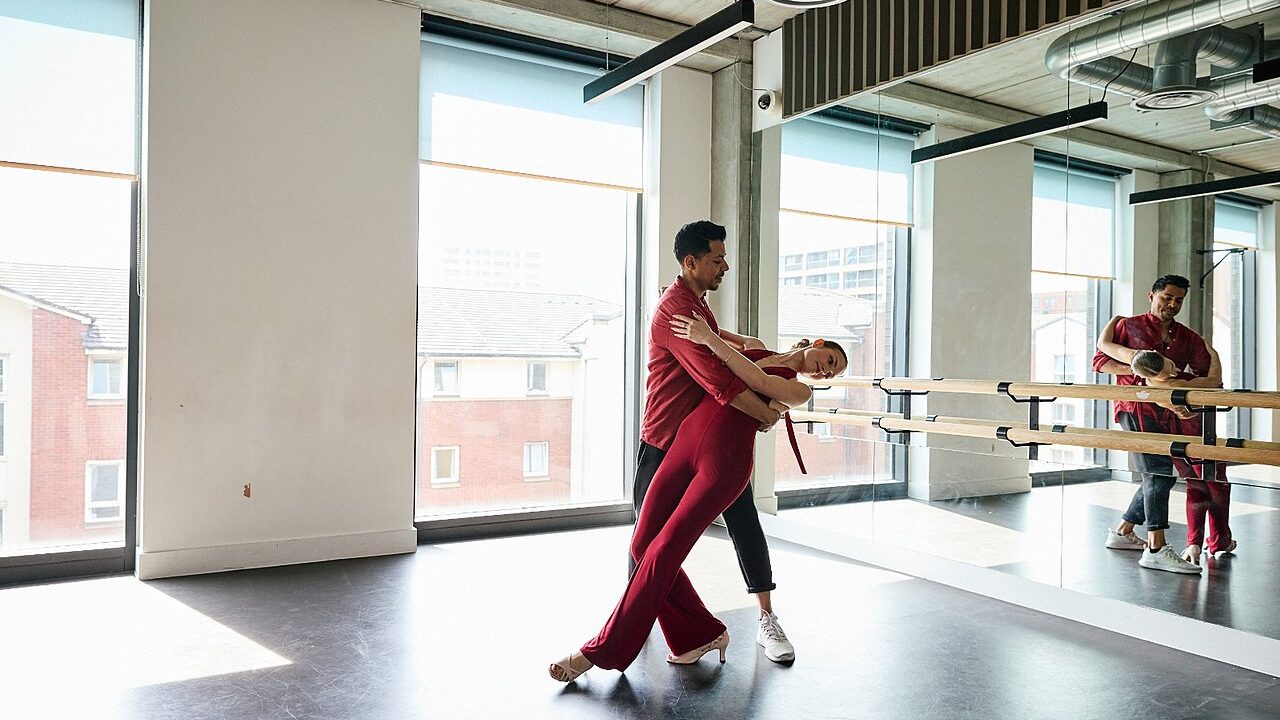
To salsa dance, you need one idea before anything else: three steps for every four beats of music. You step, step, step, then pause, and repeat. Count the music in two groups of four, 1, 2, 3, (4), 5, 6, 7, (8), step on the numbers and hold on 4 and 8. Once that pattern lives in your feet, everything else in salsa, from turns to footwork, is built on top of it. This guide covers the count, the basic step, finding the beat, and the choices beginners face.
Before you start: what salsa is
Salsa is a partner dance done to salsa music, with roots in Cuban son, mambo, cha-cha-chá and rumba. It is mostly danced in couples, with one person leading and the other following, but you can also dance it alone. The solo footwork sections are called shines.
Salsa music is fast. Its tempo usually runs from about 150 to 250 beats per minute, with most social dancing somewhere between 160 and 220. Do not let that put you off: you will learn slowly, and the speed comes on its own.
Step 1: learn the count
Salsa music is counted in eights: two bars of four beats. You step on three beats, pause on the fourth, and do the same in the second half.
Put on a salsa song and just count out loud, 1, 2, 3, 4, 5, 6, 7, 8, clapping on each number. Do it for a whole song before you move your feet. It feels silly, and it is the most useful thing you can do in your first week.
Step 2: the forward and back basic
This is the basic most beginners learn first. It is danced on 1, which means the first step, the one that changes direction, happens on beat 1. The description below is for the leader. The follower does the mirror image, starting back with the right foot on 1.
First half (1, 2, 3, pause on 4):
- On 1, step forward with your left foot.
- On 2, shift your weight back onto your right foot, without moving it.
- On 3, bring your left foot back next to your right.
- On 4, pause. Your weight stays on the left foot.
Second half (5, 6, 7, pause on 8):
- On 5, step back with your right foot.
- On 6, shift your weight forward onto your left foot.
- On 7, bring your right foot back next to your left.
- On 8, pause.
That is it: forward, rock, close, pause, back, rock, close, pause. Keep the steps small, about the length of your own foot. Big steps are the most common beginner mistake, because they make you late at fast tempos.
Step 3: the side basic
Once the forward and back basic feels easy, try the same count to the side. On 1, step to the left with your left foot, shift onto your right foot on 2, close on 3 and pause on 4. Then step to the right with your right foot on 5, shift onto your left on 6, close on 7 and pause on 8.
The side basic is useful on a crowded floor and as a rest step between figures.
Step 4: find the 1 in real music
Counting to a slow practice track is easy. Finding beat 1 in a real salsa song is harder, and it is the skill that separates people who can do the step from people who can dance.
A few tips that help:
- Listen to the percussion. Try to hear the regular pulse under the melody, and count along with it before you think about the 1.
- Follow the phrases. Salsa music changes in blocks of eight counts. When the music shifts, a new section usually starts on a 1.
- Watch dancers who know. At a social or in a video, watch when experienced dancers step forward. On 1 dancers change direction on 1 and 5.
- Use beginner playlists. Many teachers share slower songs with a very clear beat. Start with those.
Step 5: add a partner
In a couple, the leader and follower face each other and dance mirrored basics: when the leader steps forward, the follower steps back. Connection usually starts with a light hold of both hands, then moves to a closed position.
The first move most beginners learn after the basic is the cross-body lead. In LA style, the leader steps forward on 1 and then steps out of the way while turning, opening the line, and the follower walks straight forward through it on 5, 6, 7 and turns. At the end, the two have swapped places. A class is the best place to learn it, because the timing of the lead matters more than the footwork.
On 1, on 2 or Cuban style?
You will hear these terms in your first weeks. They are different ways of dancing salsa:
- On 1 (LA style): danced in a line, or slot, with the direction change on beat 1. Usually the easiest for beginners to hear.
- On 2 (New York style): also danced in a slot, but the change of direction happens on beat 2, and the follower steps forward first. It grew from the Palladium mambo and was formalised in New York by teachers such as Eddie Torres.
- Cuban style (casino): danced in a circle rather than a line, with a more grounded, earthy feel and many turns where partners wrap around each other. Its group version, rueda de casino, is danced in a circle of couples.
The best choice is simple: learn the style danced where you live. A great on 2 dancer still needs partners, and partners are wherever the socials are.
How to practise between classes
- Basics in front of a mirror, ten minutes at a time, first to slow songs, then to faster ones.
- Count out loud while you dance, until you no longer need to.
- Practise your weight change. On 2 and 6 in the basic, your feet should not move, only your weight. Getting this right makes your dancing look much cleaner.
- Go to socials early. Even if you only dance two songs, dancing with different partners teaches you more than a month of practising alone.
What to wear
You do not need special shoes for your first classes. Choose shoes with a smooth sole that lets you turn easily, and avoid trainers with a lot of grip, which can stick to the floor and strain your knees. Comfortable clothes you can move in are enough.
Frequently asked questions
What is the basic step in salsa? Three steps for every four beats. On 1: forward, rock back, close, pause, then back, rock forward, close, pause.
How long does it take to learn salsa? A simple basic with a partner can come after a few classes; feeling at ease on a social floor usually takes months.
Should I learn salsa on 1 or on 2? Learn whichever style is danced at the socials near you. On 1 is usually easier to hear at first.
Can I learn salsa without a partner? Yes. Group classes rotate partners, and you can practise the basic and shines alone.
FAQ
What is the basic step in salsa?
Salsa uses three steps for every four beats of music. In the most common beginner version, danced on 1, you step forward on 1, shift your weight back on 2, close on 3, pause on 4, then step back on 5, shift forward on 6, close on 7 and pause on 8.
How long does it take to learn salsa?
It varies a lot. Many beginners can dance a simple basic with a partner after a few classes, but feeling comfortable on a social dance floor usually takes months of regular classes and practice.
Should I learn salsa on 1 or on 2?
Learn the style danced at the socials near you. On 1 is usually easier to hear for beginners. On 2 is the New York style. Cuban style (casino) is danced in a circle rather than a line.
Can I learn salsa without a partner?
Yes. Most group classes rotate partners, so you do not need to bring one, and you can practise the basic step and solo footwork, called shines, on your own.
Sources
- Wikipedia, "Salsa (dance)"
- SalsaVida, "Mambo vs Salsa: What's the Difference?"
- The Dance Dojo, "New York Style Salsa On 2"