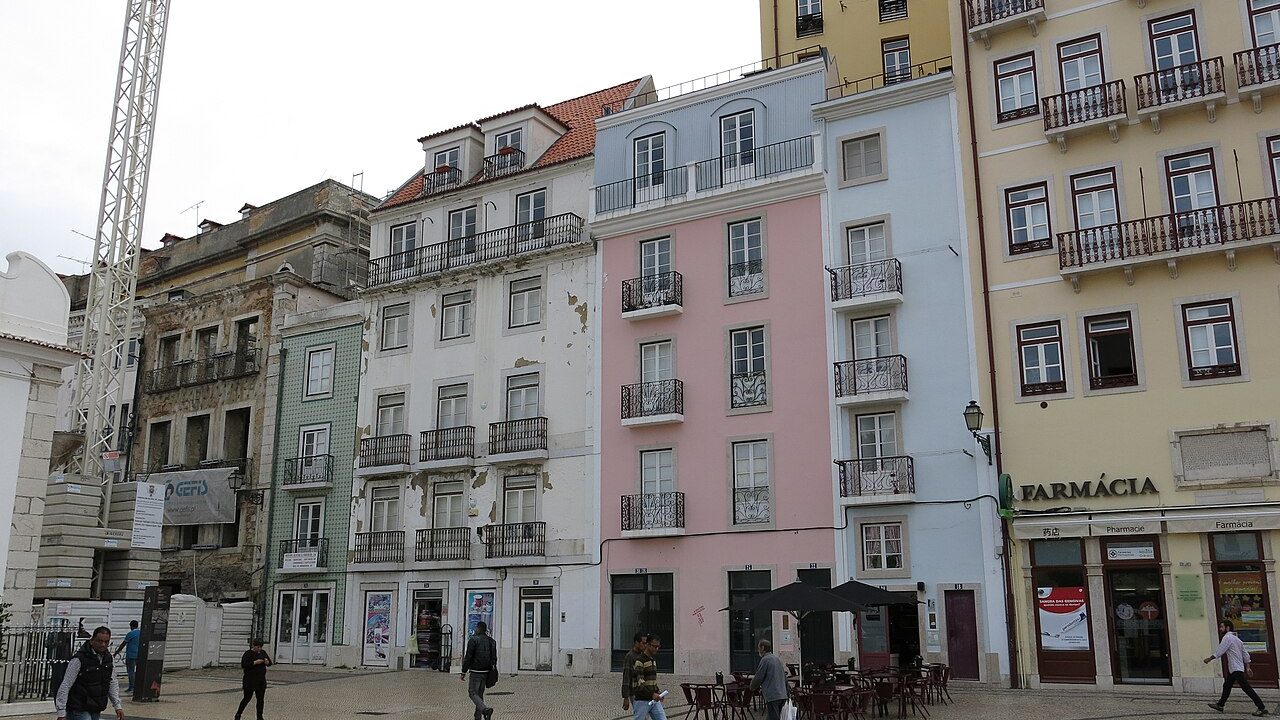
Lisbon is one of Europe's most important cities for African music, and for partner dancers it may be the most important of all. It is where kizomba was first commodified and taught as a dance in the mid-1990s, where the electronic style batida was invented by Afro-Portuguese producers, and where the label Príncipe Discos brought the sound of the city's suburbs to the world. Much of that story happens not in Lisbon itself, but in the municipalities around it.
A geography that matters
Two neighbourhoods appear in almost every story about Afro-Portuguese music, and both are often misplaced. Cova da Moura is in Amadora, and it has never been demolished. Quinta do Mocho is in Sacavém, in the municipality of Loures. Both are part of the Lisbon metropolitan area, not the city proper.
Quinta do Mocho is a social housing estate from the 1970s; a 2008 figure put the share of residents of African descent at around 90%. Since 2014 it has been known for a street art project that turned its buildings into an open-air gallery.
Where kizomba became a dance
For dancers, the most important Lisbon story is about kizomba. The anthropologist Livia Jiménez Sedano documented how the dance was commodified in Portugal in the mid-1990s. A Portuguese promoter she calls "Quim" heard the word in Angolan discotheques in Lisbon and brought in teachers to give classes in a standardised version.
She names early figures of that teaching scene: Mestre Pechú, Zé Barbosa, who arrived in 1998 and taught kizomba na passada, and Hélio Santos, who arrived in 1999. Standardisation, she writes, reduced a great variety of existing styles to a package of basic steps. It also made kizomba exportable to the whole world.
Batida, kuduro and Príncipe Discos
Lisbon also built its own electronic sounds. Kuduro came from Luanda; batida was made in Lisbon, by Afro-Portuguese producers mixing kuduro, house and other influences. The band Buraka Som Sistema (2006 to 2016) took kuduro to international festivals.
The label that defined the scene is Príncipe Discos, founded in 2011 from the merger of two initiatives: José Moura and Márcio Matos on one side, and the association Filho Único with Nelson Gomes on the other. The founders describe themselves as outsiders to the scene; their key to it was DJ Marfox.
DJ Marfox, born Marlon Silva in Lisbon in June 1988 to parents from São Tomé, grew up in Bairro da Portela. He has been a DJ since 2002 and co-founded the crew DJs do Guetto in 2005 with DJ Pausas and DJ Fofuxo. Príncipe's catalogue also documents tarraxo, the darker, slower descendant of kizomba.
Cesária Évora's Lisbon years
Lisbon was also a step in the career of Cape Verde's most famous voice. Cesária Évora relaunched her career in Lisbon from 1985, where José da Silva heard her and invited her to Paris. La Diva aux pieds nus followed in 1988 and Miss Perfumado in 1992. You will sometimes read that she is linked to cola-zouk or cabo-love; we found no source for that.
Where to listen
Venues documented in the scene include MusicBox, home of the Noite Príncipe parties, B.Leza, the Zona Não Vigiada festival in Chelas, and spots in Mouraria such as Shilabo's and São Cristóvão.
What we could not document
We looked for named artists speaking on the record about racism and housing in the neighbourhoods where this music was made. These issues are real and widely discussed, but we did not find the specific, attributable statements we would need to quote. We prefer to say so.
Lisbon's place in African music is not a footnote to Luanda or Praia. It is a story of its own, written in the suburbs and carried to dance floors everywhere. For the French side of the same story, read about Paris.
FAQ
Is batida from Angola or Lisbon?
Batida was made in Lisbon by Afro-Portuguese producers. Kuduro, one of its influences, comes from Luanda.
When did Príncipe Discos start?
In 2011, from the merger of two initiatives: José Moura and Márcio Matos on one side, and the association Filho Único with Nelson Gomes on the other.
Where was kizomba first taught as a dance?
In Portugal, from the mid-1990s, according to research by Livia Jiménez Sedano, which names early teachers such as Mestre Pechú, Zé Barbosa and Hélio Santos.
Sources
- Livia Jiménez Sedano, "Kizomba Dance: From Market Success to Controversial National Brand", Revue européenne des migrations internationales, 2019, no. 3
- Bandcamp Daily, Príncipe Discos coverage, 2016