Zouk béton is the original fast, carnival style of zouk, born in Guadeloupe and Martinique and best represented by the band Kassav' in the 1980s. It is energetic and percussion-driven, with a loud horn section and a tempo that Wikipedia puts at roughly 120 to 145 beats per minute. It is also called zouk chiré or "hard" zouk; béton means concrete. Over time, the slower, romantic zouk love took over, but zouk béton remains the sound of zouk's explosive beginnings.
Where it comes from
Zouk grew out of the French Caribbean in the late 1970s and 1980s. Wikipedia describes zouk béton as a synthesis of several French Antillean dance music styles of the twentieth century, including kadans and konpa from Haiti, alongside local traditions.
Kassav' brought it together. Britannica notes that the band used the distinctively Guadeloupean gwoka drums and drum patterns on its early recordings, and Wikipedia credits Kassav' with creating the fast carnival zouk béton style and with being the first to bring MIDI technology to cadence. The full story of the band is told in Kassav' and the birth of zouk.
The carnival connection
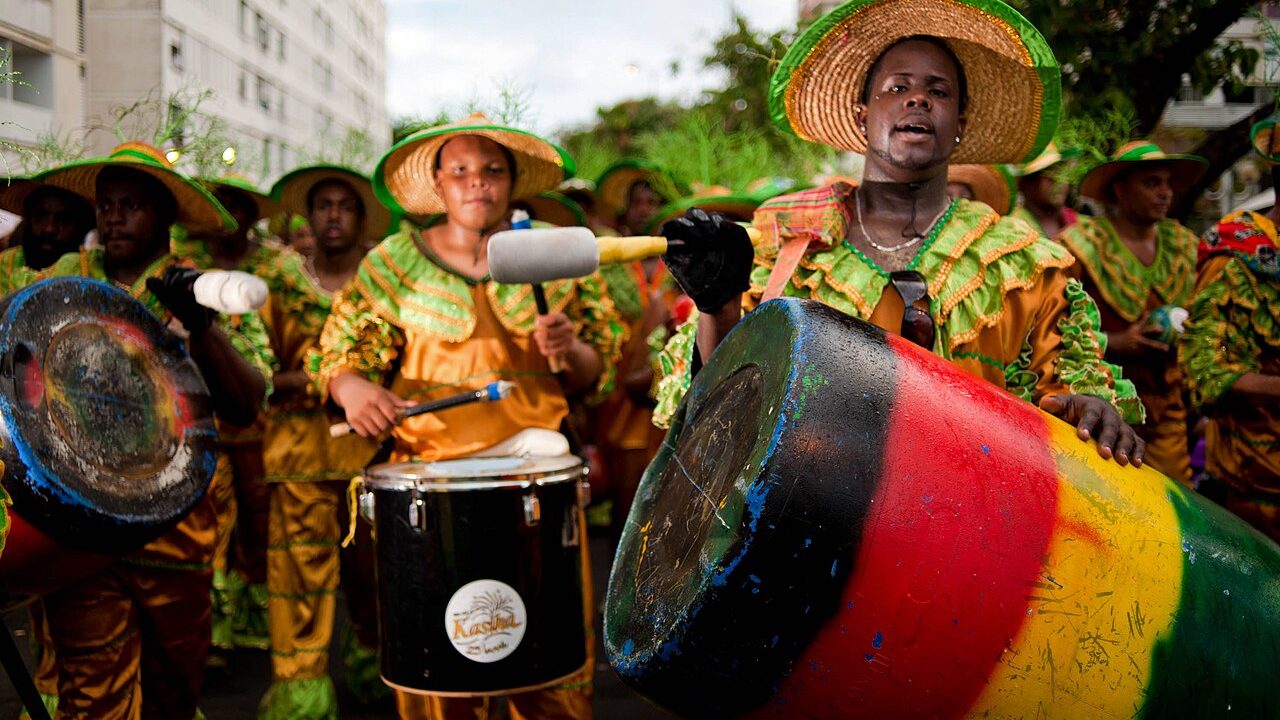
Carnival is central to zouk béton. The parades of Guadeloupe and Martinique, called vidés, were creative laboratories for modern Antillean music, the Riches Karayib cultural site explains, and zouk béton carried that collective, jump-up energy.
One of the songs most associated with that era is Kassav's "Zouk la sé sèl médikaman nou ni", "zouk is the only medicine we have". Sources differ on its date: Riches Karayib and others give 1984, while Wikipedia links it to the 1985 album Yélélé, credited jointly to Jacob Desvarieux and Georges Décimus.
How it sounds
Zouk béton is built for crowds:
- Fast tempos, often between 120 and 145 bpm.
- Driving percussion, with roots in gwoka and carnival drumming.
- A loud, punchy horn section.
- Synthesizers and drum machines, part of Kassav's modern sound in the 1980s.
- Call-and-response vocals in Antillean Creole, made for singing along.
From béton to love
As the 1980s went on, zouk slowed down. Riches Karayib describes how, led by singers such as Patrick Saint-Éloi and Jocelyne Béroard, a new form put couples, tenderness and sensuality at the centre. That slow style became zouk love, which dominated from the 1990s and is the zouk most dancers know today. We explain it in What is zouk love?.
Some sources go further and describe zouk béton as a style that faded during the 1980s, partly because it was so fast. Others point out that Kassav' kept it in their live shows for decades. Both can be true: zouk béton stopped being the main zouk sound, but it never disappeared from carnival and from Kassav's concerts.
Dancing to zouk béton
Zouk béton is not a close couple dance like zouk love. It is jump-up music: dancers move freely, bounce, follow the carnival groove and sing along. At a zouk night, the switch from slow zouk love to a burst of béton changes the whole room.
For the guitarist whose riffs defined much of that sound, read our portrait of Jacob Desvarieux.
FAQ
What is zouk béton?
The original fast, carnival style of zouk from Guadeloupe and Martinique, best represented by Kassav'. It is also called zouk chiré or zouk hard.
What is the difference between zouk béton and zouk love?
Zouk béton is fast and energetic, made for carnival and jumping. Zouk love is slow and romantic, made for close couple dancing.
Why is it called béton?
Béton means concrete in French. The name suggests a hard, heavy sound, and the style is also called 'hard' zouk.
Sources
- Wikipedia, "Zouk" and "Kassav'"
- Britannica, "Zouk"
- Riches Karayib, "Zouk: a musical journey from the West Indies to the world"