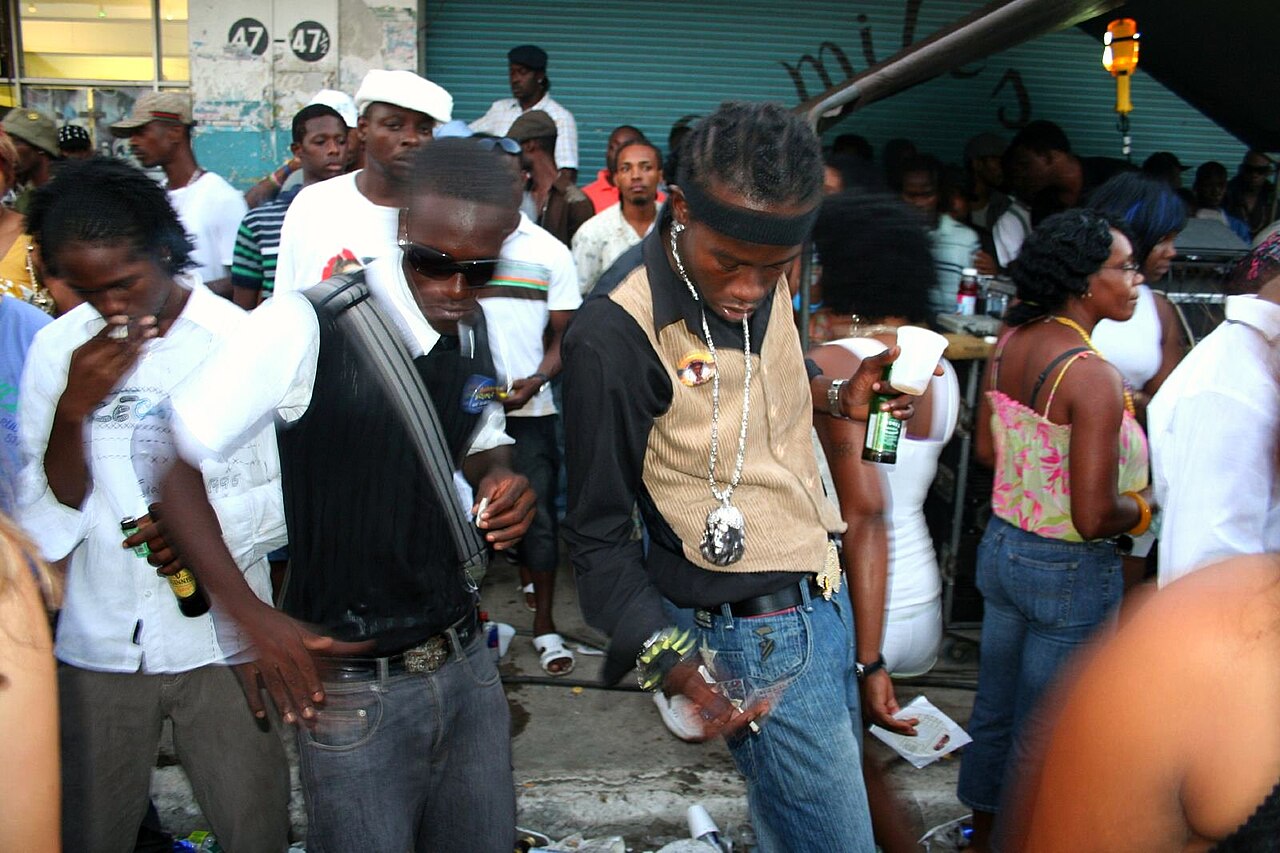
Female dancehall is the name dance schools give to the women's side of Jamaican dancehall: steps and grooves associated with female dancers and dancehall queens, built on winding hips, isolations, flexibility and attitude. It grew out of Kingston's dances in the 1990s, when women such as Carlene Smith, the first dancehall queen, became stars in their own right. Today "dancehall female" classes are taught far beyond Jamaica, in Europe, the United States and Japan. The style is loved, copied and criticised, and the debate about what it means for women is part of its story. For the history of the title itself, read Dancehall Queen.
Two sides of the same dance
Dancehall steps are often split into two families. On one side are the crew steps, many of them created by male dancers such as Gerald "Bogle" Levy and, later, Ding Dong and the Ravers Clavers, which you can discover in Dancehall steps to know. On the other is the female style, centred on the hips, the waist and the whole body's flexibility.
The dancehall instructor Yaminah Legohn, interviewed by BK Reader in 2018, pointed out that the people creating the steps in the early days were mostly men, and that she wanted to give women a different way into the style. The split is a teaching convention, not a rule: women dance crew steps, men dance female steps, and the best dancers move between both.
The queens who built it
The story of female dancehall is the story of the queens. In 1992, Carlene Smith won a contest she had helped create and named herself the Dancehall Queen. The Gleaner credits her with popularising the Butterfly, a move whose instructions came from the deejay Admiral Bailey. Her fame, her outfits and her dancing made the dancehall queen a figure that women across Jamaica wanted to become.
Contests followed in many parishes, and the best-known international competition is held in Montego Bay. In 2002 the Japanese dancer Junko Kudo became the first non-Jamaican to win it. The full story is in Dancehall Queen.
The Gleaner reported in 2018 that, according to one dancehall professional, the international interest in Jamaican dance was largely driven by the queens: female dancers were the first to bring an influx of foreign visitors who wanted to learn. Carlene herself told the paper that people came to her workshops to learn the real Jamaican style from the grassroots, not a watered-down version.
The moves
Female dancehall has its own classics, each with its story. The Butterfly belongs to Carlene's era. The Dutty Wine, a fast rotation of the neck usually performed by women, was claimed by several dancers, among them the dancehall queen Mad Michelle, before Tony Matterhorn's 2006 song made it a worldwide craze. Wikipedia notes that a trio from Montego Bay, The Attitude Girls, packaged the dance, and that Dancehall Queen Shalara Gayle became famous for doing it fastest and longest.
Behind the named steps there is a vocabulary that teachers work on in every class: wining the waist, isolating the hips and chest, controlling speed, holding a pose with confidence. The dancehall teacher Blaze told Dance Spirit that the style is isolated, fluid and staccato at the same time, and that dancehall is a lifestyle that includes music, fashion and community as well as the dance.
The debate: sexualisation or empowerment
Female dancehall is often judged before it is understood. Critics see in it a sexualised image of women. Many dancers see the opposite. Yaminah Legohn told BK Reader that the dance is about dominance, power and femininity, more than sex, and she teaches it as a way to build confidence. The MCA Chicago exhibition Dancing the Revolution described dancehall women as owning their sexuality and using it as they chose, an energy that, it says, comes from working-class women.
Researchers have taken the subject seriously. In a doctoral thesis completed at the University of Chichester in 2020, the researcher C. Monteiro studied how women in the Jamaican and European dancehall queen scene engage with the style, reading their dancing through decolonial theory.
There is no single answer, and #DANCE does not try to give one. What matters for dancers is to know that the debate exists, to respect the Jamaican women who created the style, and to understand that the outfits, the attitude and the movements come from a specific culture with its own codes.
Female dancehall and heels
In studios, female dancehall sometimes sits next to heels classes, and the two share an interest in confidence and performance. They are different styles with different histories: heels mixes jazz, hip-hop, vogue and burlesque and grew from music videos and Los Angeles studios, while female dancehall comes from Jamaican dances and sound systems. See What is heels dance? for the comparison.
How to start
Look for teachers who have trained in Jamaica or with Jamaican dancers, and who teach the names and the history along with the moves. Learn the music too: What is dancehall music? is a good start. Warm up well, because neck, back and hip work is demanding, and take your time with moves such as the Dutty Wine. Then go where the dance lives: Kingston's weekly parties are still the best school.
FAQ
What is female dancehall?
It is the name dance schools use for the women's side of Jamaican dancehall: steps and grooves associated with female dancers and dancehall queens, built on winding hips, isolations and attitude, as opposed to the crew steps created mostly by male dancers.
Who started the dancehall queen tradition?
Carlene Smith, known as Dancehall Queen Carlene, is regarded as Jamaica's first dancehall queen. She won and named the title in 1992, and is credited with popularising the Butterfly.
Is female dancehall only for women?
No. The name describes a style, not who may dance it. Some studios run women-only classes, but men also learn and dance female steps.
Is female dancehall just about being sexy?
It is often criticised that way. Many dancers and researchers describe it instead as a space where working-class Jamaican women claimed attention, confidence and control over how they present themselves. Both views exist.
Sources
- #DANCE, "Dancehall Queen", "Dancehall steps to know" and "Bogle", with their own sources
- The Gleaner, "Dancehall queens: the legacy continues", 12 November 2018
- Wikipedia, "Dancehall Queens" and "Dutty Wine", consulted November 2026
- BK Reader, "Dancehall Queen Yaminah Legohn teaches empowerment through dance", 16 July 2018
- Dance Spirit, "Dancehall 101"
- MCA Chicago, "Dancing the Revolution" exhibition text
- C. Monteiro, PhD thesis on the Jamaican and European dancehall queen scene, University of Chichester, 2020