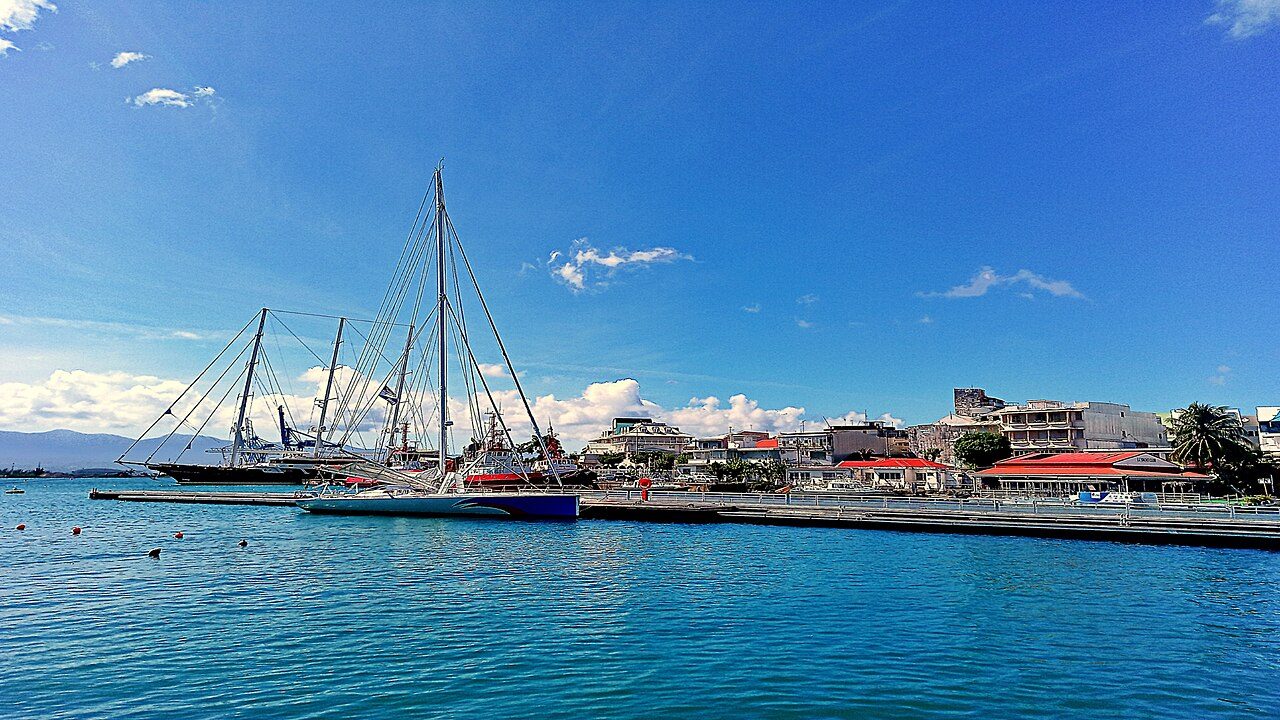
Biguine is the dance music of Martinique. It grew up in Saint-Pierre, then the island's capital, in the 19th century, when Black musicians mixed the drum tradition of bèlè with European dances such as the polka and ballroom steps. Its ballroom bands of clarinets, drums and banjos are often compared to the jazz bands of New Orleans. The eruption of Mount Pelée in 1902 wiped out its home city, but biguine survived, and in the 1920s and 1930s it became the rage in Paris, led by the clarinettist Alexandre Stellio. Wikipedia counts zouk among the styles that came after it.
Born in Saint-Pierre
Wikipedia places the birth of biguine in Saint-Pierre in the 19th century, and gives the late 1890s as its cultural origin. By combining traditional bèlè with European dance genres, the Black musicians of Martinique created a music that Wikipedia divides into three styles:
- the biguine de salon, for drawing rooms
- the biguine de bal, for dance halls
- the biguine de rue, for the street
Saint-Pierre was the right place for it. The Paris city library's music series compares it to New Orleans: a busy port with the same legacy of slavery, but also looser social relations than elsewhere. Nicknamed the "Paris of the Islands", it was the economic and cultural capital of the French Antilles. AZ Martinique adds that its ballroom orchestras looked very much like the jazz bands of New Orleans, with clarinets, drums and banjos.
Two biguines
Wikipedia makes a useful distinction. Drum biguine, called bidgin bèlè in Creole, comes from the bèlè dances of the plantations. It keeps the single-skin bèlè drum, the tibwa rhythm sticks and call-and-response singing. The orchestrated biguine of Saint-Pierre is much more influenced by French music, though its vocals are usually in Creole.
Carnival mattered too. The researcher John Cowley notes that almost a third of the repertoire recorded by Antillean musicians in Paris between 1929 and 1931 can be traced back to the political, satirical and marching songs of Saint-Pierre's carnivals.
8 May 1902
On 8 May 1902, Mount Pelée erupted. According to the Paris library series, a burning cloud swept down the volcano and killed the town's population, about 26,000 people. Afrik.com gives a figure of 30,000 victims. Either way, Saint-Pierre was destroyed, and biguine lost its birthplace.
The music did not die with the city. Cowley writes that Martinique's musical and carnival traditions survived, even if the disaster held them back for several years.
Stellio and the Paris craze
Biguine's revival came from Paris, and it owes a great deal to Alexandre Stellio (1885 to 1939), a clarinettist born in Saint-Pierre. The sources differ slightly on how he escaped the disaster: the Paris library says he left for French Guiana shortly before 1902, while Afrik.com says he arrived in Cayenne with his family after the eruption, aged 17. He then sailed for Paris in 1929, and for a decade, Afrik.com writes, he was the king of the Antillean balls.
Frémeaux & Associés, which reissued his recordings, says he was the first to record biguine, mostly his own compositions, rooted in the music of Saint-Pierre. Smithsonian Folkways notes that early Paris bands used the clarinet as the lead instrument and, later in the decade, took in more Caribbean and jazz elements.
He was not alone. Frémeaux names the clarinettist Eugène Delouche and the violinists Ernest Léardée and Roger Fanfant among the bandleaders of the time, and AZ Martinique adds Robert Mavounzy, Al Lirvat and Émilien Antile. Wikipedia also mentions Sam Castandet. The singer Léona Gabriel, known for performing with Stellio, is one of the famous voices of biguine.
The Bal Nègre of rue Blomet
The heart of the Paris scene was a dance hall at 33 rue Blomet, in the 15th arrondissement near Montparnasse. Afrik.com says the Bal Blomet was created in 1924 by the Martinican businessman Jean Rezard-Desvouves. It was known as the Bal Nègre or the Bal Colonial. According to Cowley, it drew dancers of every background, including figures of the Harlem Renaissance who visited Paris in the 1920s. INA describes it as the place where all of Paris, hungry for new culture, came to enjoy the bal nègre.
Frémeaux sums up the mood: like the tango, jazz and the rumba, the music of the French Caribbean became all the rage in Paris in the 1920s and 1930s. Afrik.com goes as far as calling it jazz before the name.
What came after
Wikipedia lists a carnival form, biguine vidé, and counts zouk among the genres that came after biguine. For the band that took zouk worldwide, read our story of Kassav'.
To hear the original, Smithsonian Folkways' Au Bal Antillais collects early recordings, including four tracks by Stellio's orchestra.
FAQ
What is biguine?
A dance music from Martinique that grew up in Saint-Pierre in the 19th century. Wikipedia describes it as a blend of the bèlè tradition with European dance genres such as the polka and ballroom dances, usually sung in Creole.
What are the three types of biguine?
Wikipedia lists the biguine de salon, the biguine de bal and the biguine de rue. It also distinguishes drum biguine, or bidgin bèlè, played on the bèlè drum and tibwa, from orchestrated biguine with clarinet and brass.
Who was Alexandre Stellio?
A clarinettist born in Saint-Pierre in 1885 who died in 1939. He moved to French Guiana around the time of the 1902 eruption, reached Paris in 1929 and became the star of the Antillean dance halls. Frémeaux & Associés says he was the first to record biguine.
What was the Bal Nègre?
A dance hall at 33 rue Blomet in Paris, also called the Bal Colonial or Bal Blomet, opened by the Martinican businessman Jean Rezard-Desvouves in 1924. It became the centre of the Antillean music scene and drew artists and visitors from all over Paris.
Is zouk related to biguine?
Yes. Wikipedia lists zouk among the fusion genres that came after biguine.
Sources
- Wikipedia, "Biguine" and "Music of Martinique", consulted 24 November 2026
- Smithsonian Folkways, "Au Bal Antillais: Creole Biguines from Martinique", album notes
- Frémeaux & Associés, "French-Caribbean Music: an introduction", consulted 24 November 2026
- Afrik.com, "Le clarinettiste martiniquais Stellio, star de la biguine dans le Paris des années 30", consulted 24 November 2026
- Bibliothèques de la Ville de Paris, "Danse & Jazz : la musique en mouvement, épisode 5", consulted 24 November 2026
- John Cowley, "Mascarade, biguine and the bal nègre", Talking Humanities, School of Advanced Study, University of London, January 2015
- INA, "Danses sans visa: dance as an identifying mark in Réunion and the West Indies", consulted 24 November 2026
- AZ Martinique, glossary entry "Biguine", consulted 24 November 2026