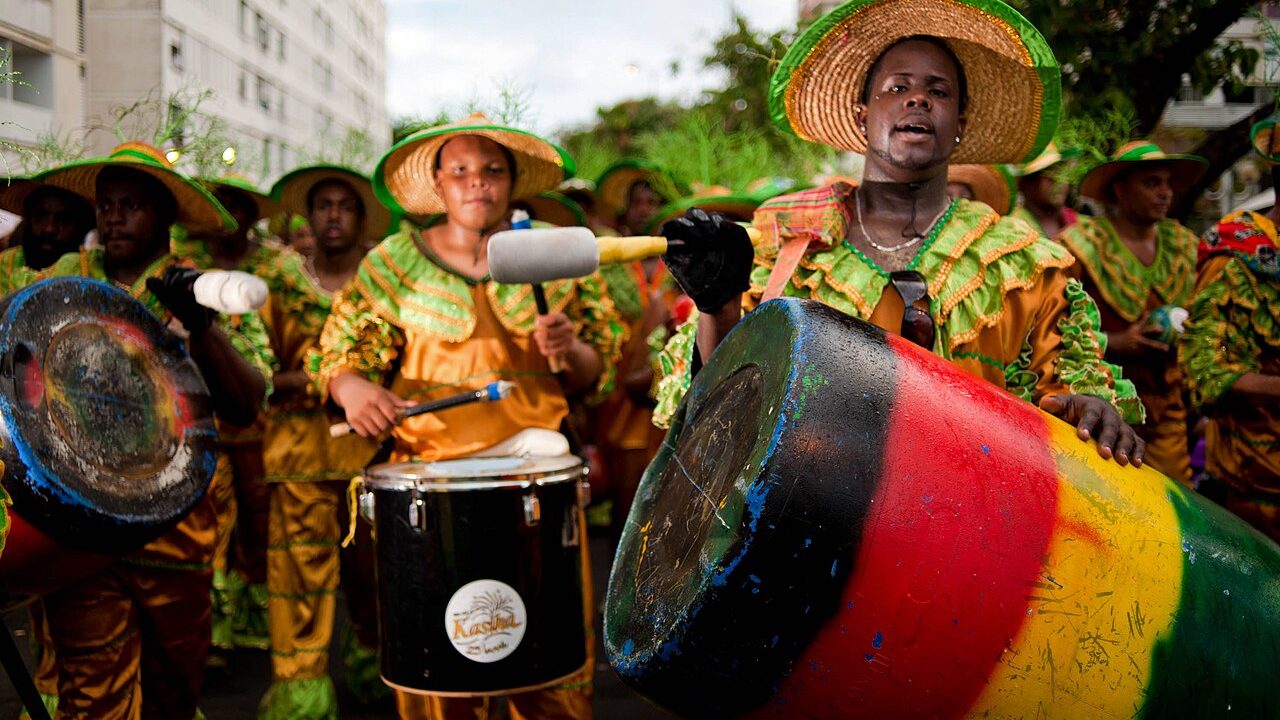
Zouk is the dance music of Guadeloupe and Martinique, the French Caribbean islands. It took shape in the late 1970s and 1980s around the band Kassav', which mixed local drumming traditions such as Guadeloupe's gwoka with Haitian compas, Dominican cadence-lypso, funk and the latest studio technology. Zouk is sung mostly in Antillean Creole, built on synthesisers, drum machines and a driving rhythm, and it exists in two main forms: the fast carnival zouk béton and the slow, romantic zouk love. The word itself means a party.
What the word means
In French Antillean Creole, zouk means a party, and more specifically a dance party. Britannica explains that the term was first used in Guadeloupe and Martinique for nightlong dance parties, and that the music played at them came to be called mizik zouk. To zouk was to party: Red Bull Music Academy quotes everyday phrases such as "On zouk ou ce soir?", where are we partying tonight.
Where the word comes from is debated:
- From the mazurka. Merriam-Webster traces zouk to mazouk, the Caribbean ballroom and club dance of the early 20th century, itself an alteration of the European mazurka.
- From "secouer". Other sources, including Red Bull Music Academy, point to the French verb secouer, to shake, which is also cited as the root of the Congolese word soukous.
Both explanations circulate, and nobody has settled the question. Merriam-Webster dates the first known use of zouk in English to 1986, which matches the moment the music went international.
Kassav' and the birth of the sound
Zouk as a genre is inseparable from Kassav'. The band was formed in 1979 by Pierre-Édouard Décimus, formerly of the Guadeloupean group Les Vikings, with the Paris studio musician Jacob Desvarieux, soon joined by Georges Décimus. Their idea was to record Guadeloupean carnival music in a fuller, more modern style. Wikipedia notes that they listened closely to the cadence and compas bands of the 1970s, from Exile One and Grammacks to Tabou Combo, and that Kassav' was the first to apply MIDI technology to cadence, fusing it with funk and Cameroonian makossa.
Britannica emphasises the studio side: early zouk stood out from its Antillean relatives thanks to its sound, its synthesisers and its sophisticated recording technology. Kassav's first audience was the Creole-speaking population of Guadeloupe, Martinique, Dominica and Saint Lucia. By 1985, with Yélélé and "Zouk la sé sèl médikaman nou ni", zouk had become a dance craze across the Caribbean and well beyond. The full story is in Kassav' and zouk and in our portrait of Jacob Desvarieux.
The ingredients
Zouk is a meeting of local and imported sounds:
- Gwoka, the drumming and singing tradition of Guadeloupe, and bélé from Martinique.
- Biguine and the Creole mazurka, the older dance musics of the islands.
- Haitian compas and cadence rampa, brought by touring Haitian bands from the 1960s.
- Dominica's cadence-lypso, popularised by Exile One.
- Funk, makossa and the synthesiser sound of the 1980s.
Wikipedia adds that, despite the strong influence of Haitian compas, zouk's rhythm remains rooted in mazouk, biguine and gwoka. Our article Kompa vs Zouk explains how the two genres shaped each other.
Zouk béton and zouk love
Zouk has two faces.
Zouk béton, also called zouk chiré or hard zouk, is the original style: fast, at around 120 to 145 BPM, percussion-driven, with a loud horn section, built for carnival and parties. Kassav' is its reference. We explain it in What is zouk béton?.
Zouk love is the slower, romantic branch that emerged from the mid-1980s and dominated the 1990s. Wikipedia notes that it slowed to around 95 to 100 BPM, replaced the horns with synthesisers and drum machines, and moved increasingly from Creole to French. Singers such as Patrick Saint-Éloi, Jocelyne Béroard and Gilles Floro shaped it. See What is zouk love?.
How zouk is danced
In the Antilles, zouk is a social dance. Zouk béton is danced loosely and festively, often apart, with the bounce of carnival. Zouk love is danced as a couple, close, with small steps and a gentle hip movement, much like Haitian kompa. There is no codified syllabus: people learn it at parties, weddings and family gatherings.
A name that travelled
Zouk's influence is wider than its own dance floors. Zouk love records reached Cape Verde and Angola in the 1980s and 1990s, where they became one of the ingredients of kizomba and Cape Verdean cabo love. In Brazil, dancers who could no longer find new lambada music started dancing to zouk records, and the dance they created took the name Brazilian Zouk. That is why the word zouk now names a Caribbean music, a Brazilian partner dance, and a whole family of influences, as we explain in Caribbean zouk vs Brazilian zouk.
Where to start listening
Begin with Kassav's albums of the 1980s for zouk béton, then move to the solo records of Jocelyne Béroard and Patrick Saint-Éloi for zouk love. Listen for the Creole lyrics, the synth lines and, under them, the old rhythm of the drums. That combination of tradition and studio is what made zouk sound like nothing else in the 1980s.
FAQ
What does the word zouk mean?
In French Antillean Creole, zouk means a party or a dance party. Its origin is debated: dictionaries link it to mazouk, the Caribbean form of the mazurka, while others connect it to the French verb secouer, to shake.
Where does zouk music come from?
From Guadeloupe and Martinique, in the French Caribbean. The band Kassav', formed in 1979, created the modern zouk sound in the late 1970s and 1980s.
What is the difference between zouk béton and zouk love?
Zouk béton is the original fast, carnival style, at around 120 to 145 BPM. Zouk love is the slower, romantic branch that dominated from the late 1980s and 1990s.
Is Brazilian Zouk the same as zouk music?
No. Brazilian Zouk is a partner dance born in Brazil from lambada. Dancers used Antillean zouk records when lambada music faded, and the dance took the music's name.
Sources
- Encyclopaedia Britannica, Shannon Dudley, "Zouk"
- Merriam-Webster, "zouk", etymology and first known use
- Collins English Dictionary via Dictionary.com, "zouk", origin
- Red Bull Music Academy Daily, "Zouk: An Introduction", December 2015
- Wikipedia, "Zouk", "Kassav'" and "Zouk love (music style)", consulted November 2026
- #DANCE, "Kassav' and zouk", "What is zouk béton?" and "What is zouk love?", with their own sources