Gwoka is the drum, song and dance tradition of Guadeloupe. It brings together three things that cannot be separated: call-and-response singing in Guadeloupean Creole, rhythms played on the ka drums, and dancing. Rooted in the African traditions of the colonial era, long dismissed as "music of the poor", it became a symbol of Guadeloupean identity from the 1960s and was inscribed by UNESCO on 26 November 2014. Its heart is the léwòz, a night gathering in which the crowd forms a circle and dancers take turns to face the drums. Here is how it works.
Roots on the plantations
Wikipedia traces gwoka's cultural origins to 17th-century Guadeloupe and its stylistic roots to West Africa. The French Ministry of Culture calls it a legacy of Guadeloupe's colonial past, passed down from generation to generation, and notes that from the 1960s, in the context of nationalist movements, it spread across the whole archipelago.
The Cambridge Companion to Caribbean Music describes how gwoka was long pushed to the rural margins, labelled mizik a vyé nèg, a pejorative phrase for "vulgar Black music", and associated with the poorest class of Guadeloupean society. Its musicians faced real discrimination before the music won recognition.
The drums: makè and boula
In a gwoka ensemble of ka drums, the drums have different roles, according to the UNESCO nomination file:
- The makè (or markeur), the lead drum, translates into sound the gestures, steps and attitudes of the dancer. It improvises.
- The boula drums, one, two and often three of them, play the steady rhythmic ostinato on which the dancer builds.
- The chacha, a rattle, and often the tibwa, two sticks, complete the ensemble.
The voice leads it all. A soloist sings in Creole and the audience answers in chorus and claps along.
The seven rhythms
Gwoka rests on a set of basic patterns, usually counted as seven rhythms. The UNESCO file lists them as léwòz, menndé, kaladja, toumblak, padjanbel, woulé and graj. Drummers build their improvisations on top of them. Some older rhythms, the Cambridge Companion notes, are rarely played today.
The léwòz: the circle
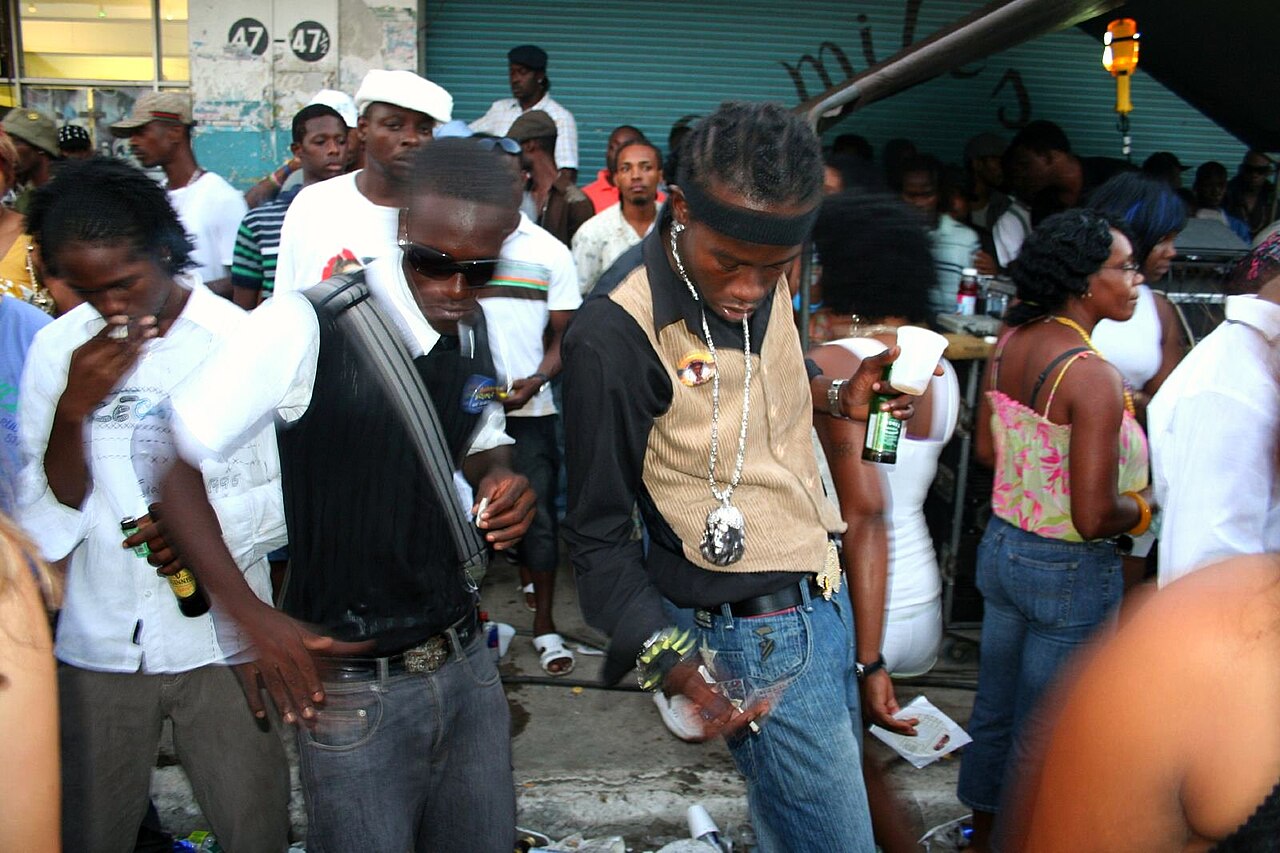
The léwòz is gwoka's main space of expression. UNESCO describes a night gathering where all participants, including the audience, form a circle called the lawonn, whose free centre welcomes the dancers. They enter one at a time and dance facing the drums. Entering the circle follows its own codes, and so does playing the ka.
Historically, Wikipedia notes, léwòz were held every other Saturday near the bigger plantations, on payday, and on each Saturday of the carnival season. The Cambridge Companion describes open-air swaré léwòz running from ten at night until five in the morning. UNESCO adds that several thousand people still regularly take part in open-air gwoka evenings, where the circle works as a place to develop individual talent.
The role of women has changed over time. Until the middle of the 20th century, UNESCO notes, women helped prepare the léwòz alongside men and sang, but only a few danced in the circle.
How gwoka is danced
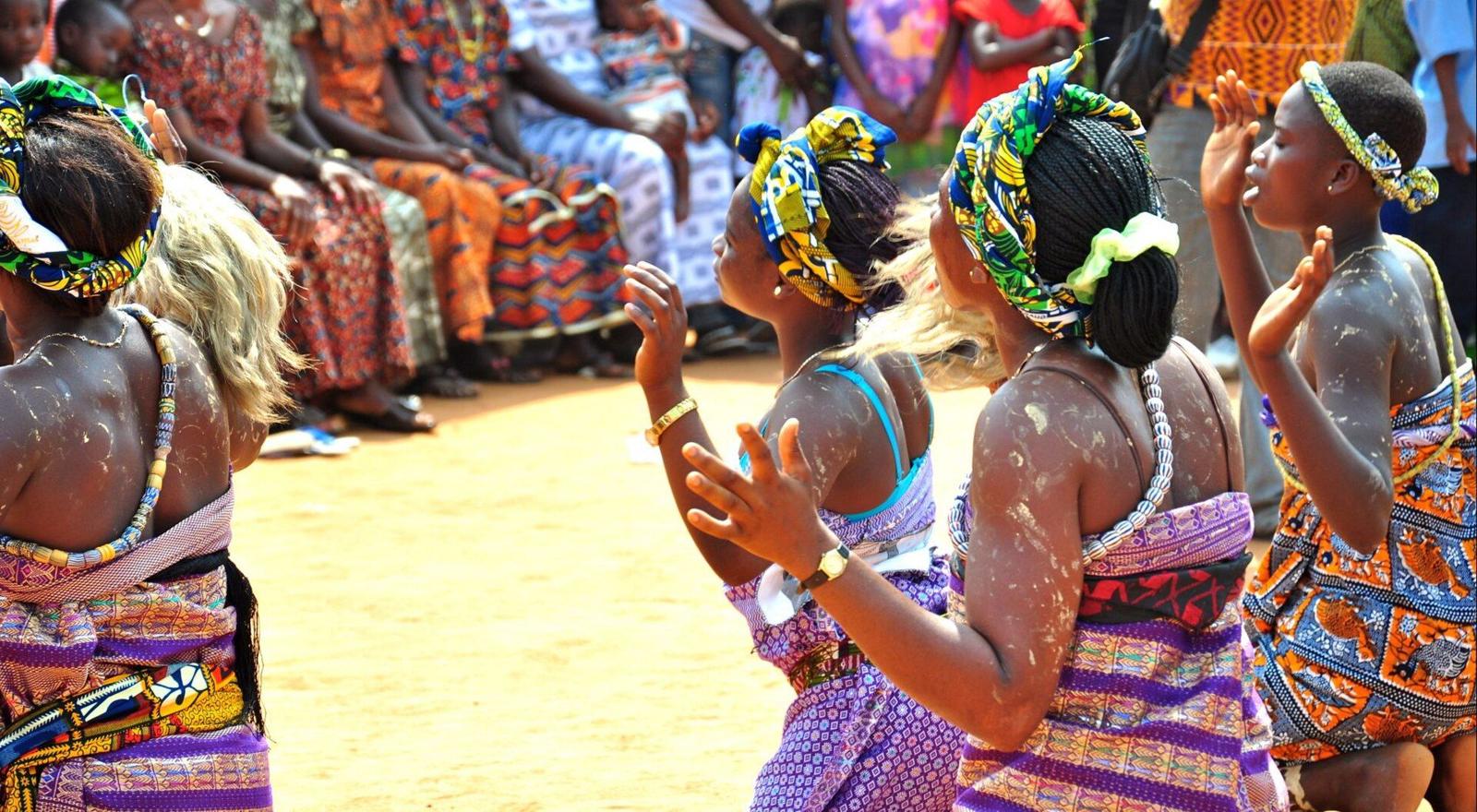
The gwoka dancer is a soloist in conversation with the makè. The drummer reads the dancer's steps and gestures and answers them, so the dance and the lead drum improvise together. A doctoral thesis defended at the Université des Antilles in 2021 describes the Guadeloupean dancing body in the swaré léwòz as one that expresses itself freely in time, space and form.
That is why gwoka is not learned like a partner dance with set figures. You learn the rhythms, the codes of the circle and how to talk with the drum, then you find your own voice.
Vélo and the first records
Gwoka's modern history has its heroes. Marcel Lollia, known as Vélo, born in 1931 in the countryside of Pointe-à-Pitre, was a master tambouyé, or ka player. The Cambridge Companion credits him with raising gwoka to the status of a national music. The first 33 rpm record, Vélo et son Gros-Ka (1963), featuring Vélo and the boula player Arthème Boisbant, was produced by Marcel Mavounzy, the first local record producer of gwoka, and is seen as a turning point in how the music was shared and learned.
The singer Guy Konkèt, called the soul of gwoka and nicknamed the "Bob Marley of Guadeloupe", is another great name. The University of Exeter's Cast in Stone database notes that Vélo was briefly part of the group that took the name Akiyo.
Gwoka modèn and beyond
In the late 1960s and 1970s, the guitarist Gérard Lockel, a jazz musician who had made his name in France, returned to Guadeloupe and began bringing melodic instruments into gwoka. The result became known as gwo ka modèn. Sources date his work from 1969 (the Paris city listings) to the 1970s (Bandcamp Daily), with a triple album in 1976 and a treatise, the Traité de gwoka modèn, in 1981.
Since then, UNESCO notes, artists have explored new paths, from gwoka modèn and gwoka jazz to techni'ka, which are performed on stage rather than in the léwòz. Gwoka has also been fused with zouk, the music Kassav' built in the 1980s; read Kassav' and zouk. For other Caribbean carnival sounds, see What is bouyon? and What is shatta?.
UNESCO and today
On 26 November 2014, during the ninth session of its Intergovernmental Committee in Paris, UNESCO inscribed "Gwoka: music, song, dance and cultural practice representative of Guadeloupean identity" on its Representative List, on France's nomination. UNESCO describes it as practised by all ethnic and religious groups of Guadeloupean society, and as one of its most emblematic elements.
Today gwoka is played on stage and still lived in the léwòz circle. If you visit Guadeloupe, a swaré léwòz is the best way to understand it.
FAQ
What is gwoka?
A Guadeloupean tradition that combines call-and-response singing in Guadeloupean Creole, rhythms played on ka drums and dancing. UNESCO describes it as practised by all ethnic and religious groups of Guadeloupean society.
What are the drums in gwoka?
The ka drums. The makè, or markeur, improvises and answers the dancer's gestures, while one, two or often three boula drums play the steady rhythmic ostinato. A chacha (rattle) and often a tibwa (sticks) join them.
What are the seven rhythms of gwoka?
According to the UNESCO nomination file, the codified rhythms are léwòz, menndé, kaladja, toumblak, padjanbel, woulé and graj.
What is a léwòz?
The main setting of gwoka: a night gathering where everyone, audience included, forms a circle called the lawonn. Dancers enter the free centre one at a time and dance facing the drums.
When was gwoka inscribed by UNESCO?
On 26 November 2014, at the ninth session of UNESCO's Intergovernmental Committee in Paris, on France's nomination.
Sources
- UNESCO, "Gwoka: music, song, dance and cultural practice representative of Guadeloupean identity", decision 9.COM 10.17 (2014), and nomination file 00991
- French Ministry of Culture, press release on the inscription of gwoka, November 2014, and "Le gwoka, un pilier culturel de la Guadeloupe", 23 April 2025
- Wikipedia, "Gwo ka", consulted November 2026
- The Cambridge Companion to Caribbean Music, chapter on gwoka's celebrated musicians
- Cast in Stone database, University of Exeter, entry on Marcel Lollia (Vélo)
- Bandcamp Daily, "New directions in gwoka", 24 February 2022
- Paris.fr, "Lockel & Gwo-Ka Modèn Explorations", January 2025
- Thèse, Université des Antilles, 2021 (theses.fr 2021ANTI0643), on léwòz, bèlè and kasékò