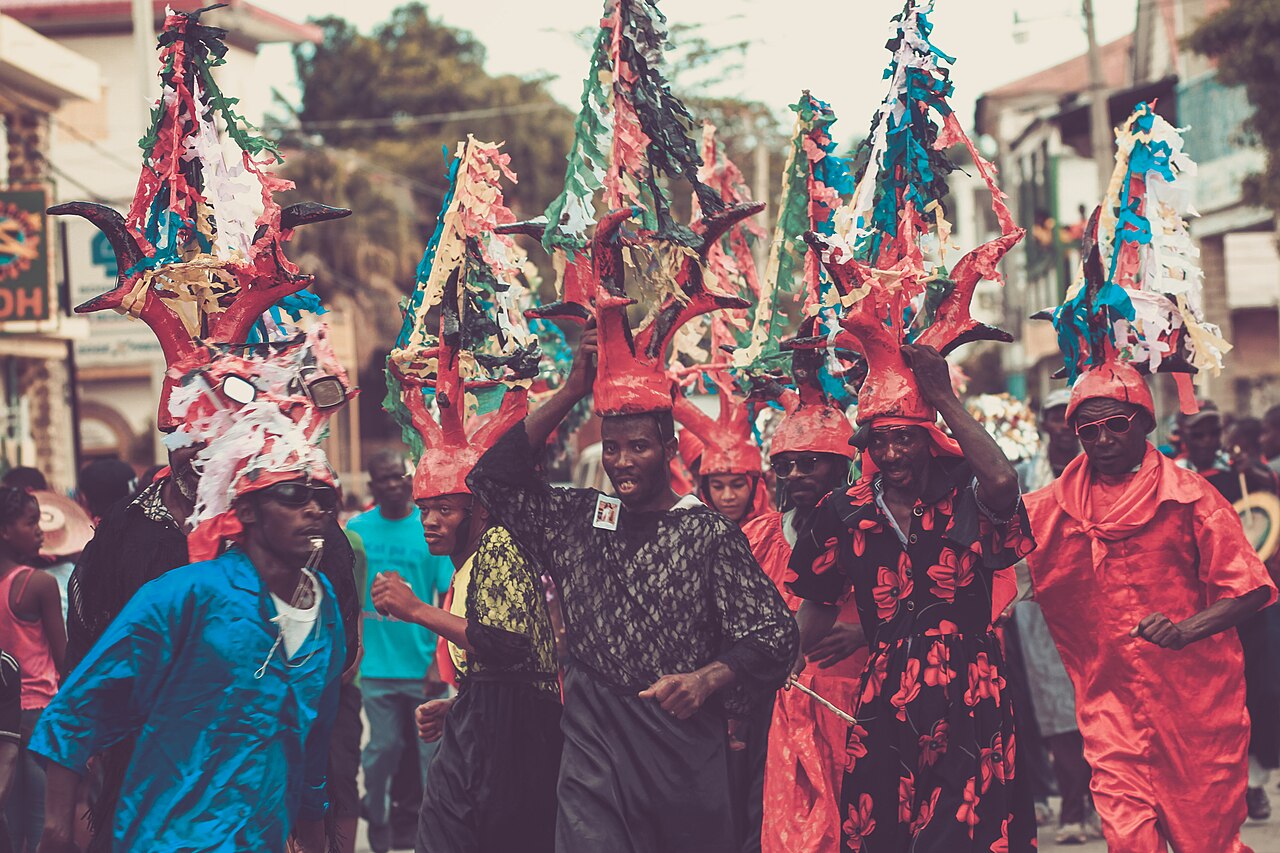
Mizik rasin, or simply rasin, is Haitian roots music. It takes the drums, songs and rhythms of Vodou ceremonies and of rara street bands, and plays them with electric guitars, bass and keyboards, borrowing from rock, reggae, funk and jazz. The style began in the late 1970s and broke through after the fall of the Duvalier dictatorship in 1986. Its best-known bands, Boukman Eksperyans, Boukan Ginen and RAM, wrote songs that became protest anthems, and some were banned by the army.
What the name means
Rasin is the Haitian Creole word for "roots". Wikipedia explains that the music links back to the roots of Vodou tradition, which is how it came to be called mizik rasin. Wikipedia gives its cultural origin as 1977 in Haiti, when musicians began combining Vodou ceremonial and folk music with other styles.
The ethnomusicologist Gage Averill, quoted by Duke University's Black Atlantic project, describes it as "neo-traditional music": a modern sound that tries to bring back something of the sound and spirit of the old models.
The sound
Rasin bands build their songs on two families of Vodou drumming. Wikipedia describes the "cool" rada rhythms, often linked to Africa, and the "hot" petro rhythms, which refer to the New World, and notes that bands rarely use both in the same song. On top come rock and jazz song structures.
The line-up mixes old and new: rada and petro drums, rara horns, electronic keyboards and drums, electric guitar and bass, singers and percussion. According to Wikipedia's page on Haitian music, Boukman Eksperyans, Boukan Ginen and, to a lesser extent, RAM brought reggae, rock and funk rhythms into traditional forms such as rara, carnival music and the spiritual music of the countryside.
Under Duvalier, and after
The political background matters. Wikipedia explains that François Duvalier and his son Jean-Claude used the authority of Vodou to support their rule. When Jean-Claude Duvalier fled in 1986, a wave of dechoukaj, "uprooting", swept away the most oppressive parts of the regime. Musicians turned to Vodou rhythms, lyrics and instruments to create a new sound, and Haitian artists from the diaspora came home.
PBS notes that after 1986, kompa itself was shaken by politically charged lyrics, largely influenced by the "Vodou rock" of Boukman Eksperyans, RAM and other rasin groups. Encyclopedia.com goes further, describing a roots movement that set the raw music of freed slaves against the light kompa dance style favoured by the Duvalier family.
Boukman Eksperyans
The founding band of the movement is Boukman Eksperyans. According to Wikipedia, it was formed in 1978 by Theodore "Lolo" Beaubrun, his sister Marjorie, Daniel Beaubrun and his wife Mimerose "Manzè" Beaubrun, with members of other groups. Some sources, such as Shazam, give 1987 instead. The name honours Dutty Boukman, the Vodou priest whose 1791 ceremony is widely seen as the start of the Haitian Revolution. Eksperyans is Creole for "experience", a nod to the Jimi Hendrix Experience.
Lolo Beaubrun had heard Bob Marley in 1976 and wanted to do something similar with Vodou. Back in Haiti, he found that the mini-jazz bands ignored real life in their lyrics. He and Mimerose went into Vodou lakou communities to study the music.
At the 1990 Carnival in Port-au-Prince, their song "Kè m pa sote", "I am not afraid", was the most popular of the season. It was widely understood as a criticism of the military government of General Prosper Avril. Wikipedia reports that armed soldiers tried to stop the band from playing it and other censored songs. Their debut album, Vodou Adjae (1991), was nominated for a Grammy.
After the military overthrew President Jean-Bertrand Aristide in 1991, the band left Haiti for its own safety and spoke out abroad against the regime of Raoul Cédras. It returned in 1994, when Aristide was restored.
Boukan Ginen and RAM
In 1990, Encyclopedia.com notes, several musicians left Boukman Eksperyans to form Boukan Ginen. Its name joins boukan, a bonfire, and Ginen, the Haitian name for the ancestral African homeland. The band won the prize for best carnival song in 1991 with "Pale pale w", and in 1994 received the Prix Découverte from Radio France Internationale.
RAM takes its name from the initials of its founder, Richard A. Morse, who describes its music as "Vodou rock 'n' roots". The band began performing in 1990. At the 1992 Carnival, months after the coup against Aristide, RAM played "Fèy". The song had no openly political words, but it became an unofficial anthem for Aristide's supporters. By the summer of 1992, Wikipedia says, the military had banned anyone from playing or singing it, and Morse received death threats. The song later appeared on RAM's 1996 album Aïbobo.
The wider movement
Wikipedia lists many other rasin artists, among them Boukan Ginen, Bwa Kayiman, Emeline Michel, Erol Josué and Kalfou Lakay. PBS also names Manno Charlemagne, the singer-songwriter of mizik angaje, "engaged music". Duke's Black Atlantic project mentions groups such as Kanpech, Tokay and Chandèl in Haiti, and Azaka abroad.
The style keeps evolving. CBC Music traces the newer rabòday sound back to rasin, and calls Boukman Eksperyans the biggest original rasin band still playing.
Where to start
Begin with Boukman Eksperyans' Vodou Adjae, then RAM's Aïbobo and Boukan Ginen's Jou a rive (1995). To understand the street music behind it, read What is rara?, and for the dance-band side of Haiti, What is kompa?.
FAQ
What is mizik rasin?
Haitian roots music, or rasin, a style that combines the drums, songs and rhythms of Vodou ceremonies and rara with rock, reggae, funk and jazz. It began in Haiti in the late 1970s and became popular after 1986.
What does rasin mean?
"Roots" in Haitian Creole. The name refers to the music's return to Vodou and rural traditions.
Who are the main mizik rasin bands?
Boukman Eksperyans, founded by the Beaubrun family, Boukan Ginen, formed by former Boukman members around 1990, and RAM, led by Richard A. Morse. Singer-songwriter Manno Charlemagne is also often associated with the movement.
What is the difference between mizik rasin and kompa?
Kompa is Haiti's main dance-band music, built for parties and carnival. Mizik rasin draws on Vodou rhythms and rara, and its lyrics are often social and political. PBS describes it as concerned with the social and the political, unlike the festive tunes of kompa bands.
Why was Boukman Eksperyans famous?
Their song "Kè m pa sote" ("I am not afraid") was the most popular song of the 1990 Port-au-Prince Carnival and was heard as a criticism of the military government. Their debut album Vodou Adjae (1991) was nominated for a Grammy.
Sources
- Wikipedia, "Rasin", consulted 24 November 2026
- Wikipedia, "Boukman Eksperyans", "Boukan Ginen" and "RAM (band)", consulted 24 November 2026
- Wikipedia, "Music of Haiti", consulted 24 November 2026
- PBS NewsHour, "Haiti music", consulted 24 November 2026
- Encyclopedia.com, "Boukman Eksperyans", consulted 24 November 2026
- Duke University, Black Atlantic project, "Bois Caïman as a symbol of resistance", consulted 24 November 2026
- Shazam, artist page "Boukman Eksperyans", consulted 24 November 2026
- CBC Music, "A primer on Haiti's music scene", 2015