Rara is Haiti's street festival and the music that goes with it. Bands of drummers, singers, dancers and players of bamboo trumpets called vaksen parade through towns and villages from Carnival through Lent, and the festival peaks in Holy Week, just before Easter. The scholar Elizabeth McAlister, writing for the Smithsonian, sums it up as at once a season, a festival, a genre of music, a religious ritual and a form of dance, and sometimes a form of political protest. Today, the Smithsonian notes, the biggest rara bands even borrow brass players from kompa bands.
A festival that runs through Lent
Wikipedia describes rara as a traditional carnival separate from the main pre-Lent celebrations. Processions take place by day, and sometimes by night, throughout Lent, and build to a week-long celebration during Holy Week. McAlister adds that rara activity starts as early as 6 January, the Christian Epiphany.
The sound announces the parade before you see it. According to McAlister, it carries for miles, so fans know the band is coming. Bands stop at solemn places, such as cemeteries, where they salute the ancestors.
Rara is old. The Smithsonian article traces it back to slavery times in Haiti and, before that, to West and Central Africa. Wikipedia says the festival probably developed during the period of colonial slavery.
The vaksen and the hocket
The heart of rara is the vaksen (also spelled vaksin or vaccine). Wikipedia describes it as a rudimentary single-note trumpet: a simple tube, usually bamboo, with a mouthpiece at one end. It can also be made from metal pipe.
Since each vaksen plays only one note, a melody needs several players. McAlister explains that each horn is cut to a different length, from long bass tubes to short high ones. Each player blows a single note, and together they build a tune by alternating, a technique called hocket. At the same time, players beat a rhythm, called kata, on the bamboo with a stick.
Around the vaksen, Wikipedia lists drums, maracas, güiras or güiros, metal bells and tin trumpets made from recycled metal, often coffee cans. McAlister calls these metal horns konet. Modern bands may add standard trumpets, saxophones and even guitars, as Global Press Journal reports.
Where the vaksen comes from is debated. Wikipedia notes that the Haitian ethnographer Jean Bernard traced it to the island's pre-colonial peoples, while other scholars link it to the single-note bamboo trumpets of the Bakongo of Central Africa. The music historian Michael Largey cites the idea that bamboo trumpets may have started as the band music of the Maroon armies that fought the colonists in the Haitian Revolution.
Kings, queens and baton majors
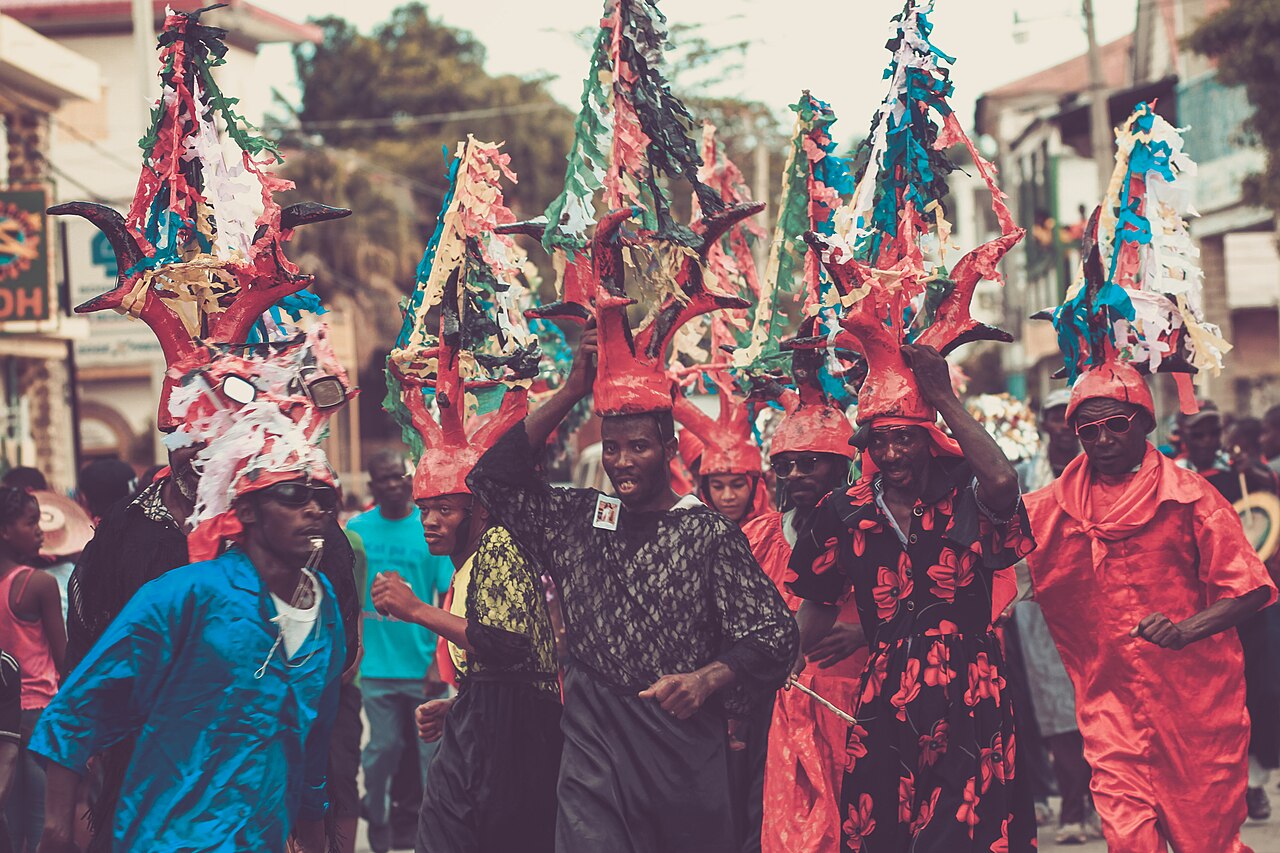
A rara band is also a show. McAlister describes two kinds of core performers: baton majors (majò jon), who juggle batons and even machetes, and kings and queens (wa and renn), who sing and dance for contributions from the crowd. Queens and fans form a chorus that sings and dances along.
The costumes are part of the spectacle, with delicate sequin work and colourful streamers falling over knickers and from hats. Al Jazeera adds that bands also use metal bells, maracas and drums.
Women run bands too. Global Press Journal reported on Voudoula, an all-female rara band from Pétion-Ville, near Port-au-Prince.
Vodou at the core
Rara is a carnival, but not only that. McAlister explains that most rara bands have a lwa, a Vodou spirit, as patron, often the spirit who asked for the band to be formed. The rara is a gift to that spirit. Most of these spirits belong to the Petwo branch, rooted in Kongo civilization, and some to the Rada branch, of Dahomean and Yoruba origin. The inner circle of band leaders are often heads of Vodou societies.
On the road, bands salute sacred places: ancestors' graves, trees, rocks and crossroads. In her book Rara! Vodou, Power, and Performance in Haiti and Its Diaspora (2002), McAlister describes an outer layer of Carnival "play" wrapped around an inner, protected layer of religious "work".
Al Jazeera puts it in simpler terms: rara gives Haitians a chance to celebrate their Vodou beliefs alongside the Catholic calendar.
Léogâne and beyond
The town of Léogâne is the best known for its rara. McAlister notes that its bands bring in brass musicians from kompa bands and play at very high volume. Radio Haïti, in an archived report held by Duke University, interviewed the leader of the band Rara Chyen Mechan about the history of rara in Léogâne.
Rara also travels. McAlister notes that it is played in summer in Haitian communities in Miami, New York, Boston and Montreal. One Haitian in New York told her that rara made them feel "in my real skin".
Rara also fed Haiti's roots music, mizik rasin, which mixes its horns with rock and reggae. It has reached electronic music, too. Wikipedia describes rara tech, a style that emerged in Haiti in the early 2010s, blending rara with house music.
How to listen
Smithsonian Folkways has published field recordings of rara, with notes by Verna Gillis and Gage Averill, which are a good starting point. For Haiti's dance-band side, read about the mini-jazz era and Tabou Combo.
FAQ
What is rara?
A Haitian festival and the music that goes with it. Rara bands parade through the streets with drums, bamboo trumpets called vaksen, tin horns and singers, from Carnival through Lent and up to Easter Week.
When does rara take place?
According to the Smithsonian, rara activity begins on 6 January, the Epiphany, starts in earnest with Carnival and continues through Lent, peaking during Holy Week before Easter. In the diaspora, rara is also played in summer.
What is a vaksen?
A simple single-note trumpet, usually a bamboo tube with a mouthpiece. Each player sounds one pitch, and together they build a melody by alternating notes, a technique called hocket, while also tapping a rhythm on the tube with a stick.
Is rara religious?
Partly. Most rara bands have a Vodou spirit as patron, and their leaders are often heads of Vodou societies. The scholar Elizabeth McAlister describes an outer layer of Carnival play around an inner layer of religious work.
Where is the most famous rara?
In Léogâne, south-west of Port-au-Prince. The Smithsonian notes that its bands use brass players from kompa bands and play at very high volume. Rara is practised all over Haiti and in Haitian communities in Miami, New York, Boston and Montreal.
Sources
- Elizabeth McAlister, "Rara: Vodou, Power, and Performance", Smithsonian Music, March 2016
- Wikipedia, "Rara music", "Haitian Carnival" and "Vaccine (instrument)", consulted 24 November 2026
- Smithsonian Folkways, liner notes by Verna Gillis and Gage Averill, Rara in Haiti
- Al Jazeera, "Haitian music groups celebrate carnival", April 2014
- Michael Largey, Historic Brass Society Journal, 2012
- Global Press Journal, report on the all-female rara band Voudoula
- Radio Haïti archive, Duke University, "Ankèt sou rara, Leyogàn"